Helping you better understand securitized credit
Demand for securitized credit remains strong. Indeed, we expect the currently addressable US$1.3 trillion securitized credit market available to European investors to continue to grow; driven by high-quality fundamentals, low correlation to traditional fixed income, predominantly floating-rate exposure and a spread premium that has historically compensated for structural complexity rather than inferior credit quality.
Below, we explain what it is and how it works.
Download the full primer which also explores why you should invest, the structural protections, ways to access it and risks to consider.
Click here to discover more insights on our securitized credit landing page.
What is securitization?
Securitization is the process of pooling individual assets and using the cash flows they generate to issue tradable bonds, known as asset-backed securities. Securitization fulfils two purposes:
- It enables originators – banks and other lenders – to diversify their funding sources, and redeploy freed-up capital into new lending, a key process for the real economy to function. They do this whilst retaining meaningful economic risk to ensure interests remain aligned.
- It provides investors with access to diversified, real economy cash flows such as mortgage payments, consumer credit, and corporate loans which would otherwise be inaccessible or illiquid.
How does securitization work in practice?
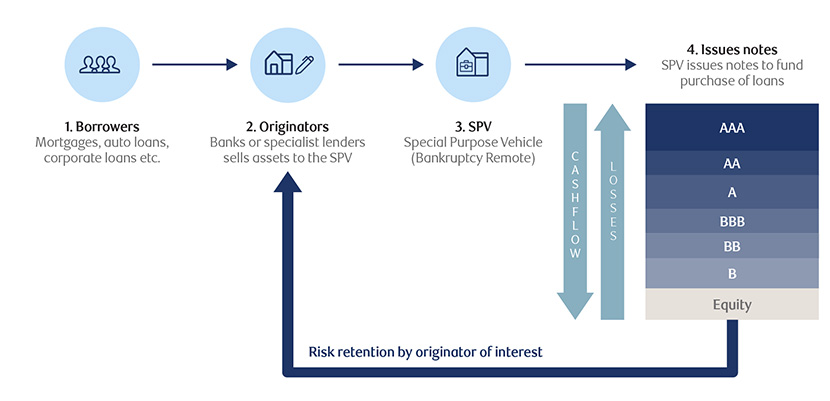
The first step in the securitization process occurs when the originator – for example a bank that has issued real estate mortgages – agrees to sell assets to a special purpose vehicle (SPV). The SPV holds the assets in legal isolation from the originator, meaning that even if the originator were to fail, investors' claims on the underlying assets are protected. Against those assets, the SPV issues bonds to investors.
Figure 1: How Securitization works
RBC BlueBay Asset Management, as at 29 July 2026. Illustrative only.
The underlying assets, known as collateral, generate cash flows, which the SPV structures into securities with different risk and return characteristics through a process called tranching. This creates a credit hierarchy – commonly referred to as a ‘waterfall’ – that determines who gets paid first when cash flows are distributed each payment period, and who absorbs losses first if those cash flows fall short.
This is illustrated in figure 1. The structure is specifically designed so that even if a proportion of underlying loans default, the most senior bondholders are protected by the subordinated tranches below them. While the level of credit enhancement can vary by sub-asset type and region, the commonality is that senior tranches (the top of the credit hierarchy) have significant cushion against defaults.
An independent credit rating agency will assess these structures. The most senior bonds are typically rated AAA and offer the lowest yield, reflecting their greater structural protection. Bonds are then issued at progressively lower ratings, each offering higher potential yields in compensation for taking on greater risk. Most securitized bonds pay a floating-rate coupon (typically measured as a spread above a benchmark interest rate such as Euribor1, SONIA2 or SOFR3), rather than a fixed coupon.
More specific to collateralized loan obligations (CLOs) – senior secured corporate loans – is an additional equity tranche, which sits below the rated bonds. This represents residual ownership of the SPV's assets after all other obligations are met. It carries no fixed coupon, instead receiving whatever cash flows remain after all rated tranches have been paid. The equity tranche carries the highest risk: it is the first to absorb losses if cash flows fall short. Although other types of securitized assets have an equity tranche it is usually held by the originator, and generally is not actively traded.
What are the main categories of securitized credit?
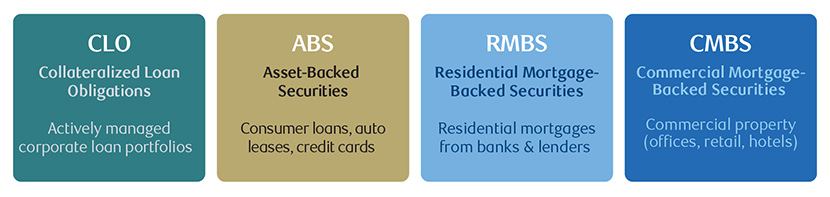
The underlying assets used in the securitization are referred to as the collateral backing the bonds. SPVs typically focus on one collateral type that share similar economics and servicing behaviour. The main categories, or sub-asset classes, of securitized credit are illustrated in figure 2.
Figure 2: Categories of securitized credit
Source: RBC Global Asset Management
Ultimately, the acronyms here indicate which type of assets underpin the bonds. What is common to them all is that they have contractual obligations to make payments. These are used to finance coupon and principal payments to investors holding the securities.
What is the securitized credit opportunity set for European investors?
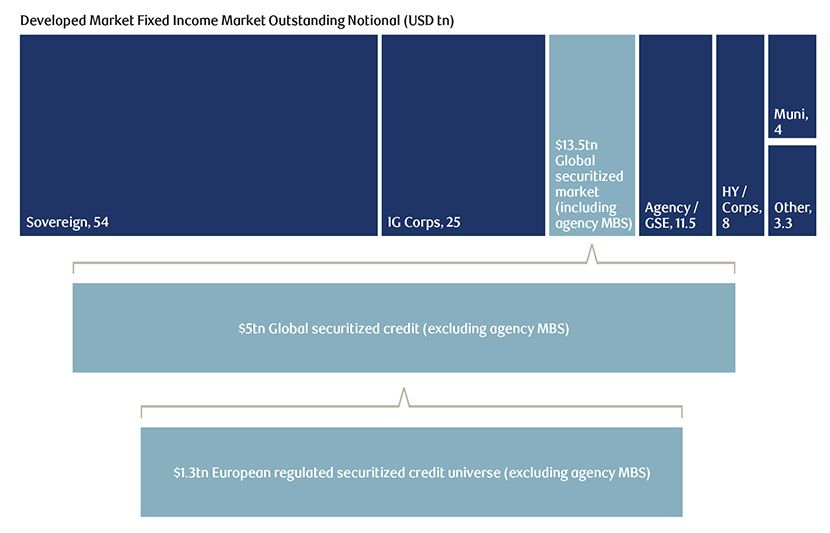
The ongoing growth and development of the securitized credit market has seen the asset class become mainstream. Global securitized assets now stand at around US$13.5 trillion. Excluding agency MBS (bonds backed by government agencies) that carry no credit risk and function as interest rate products rather than credit products, the total is around US$5 trillion, with $1.3 trillion the European regulated non-agency investable universe.
Figure 3: Where securitized credit sits in the fixed income landscape
RBC Global Asset Management, MSCI, as at 30 June 2026
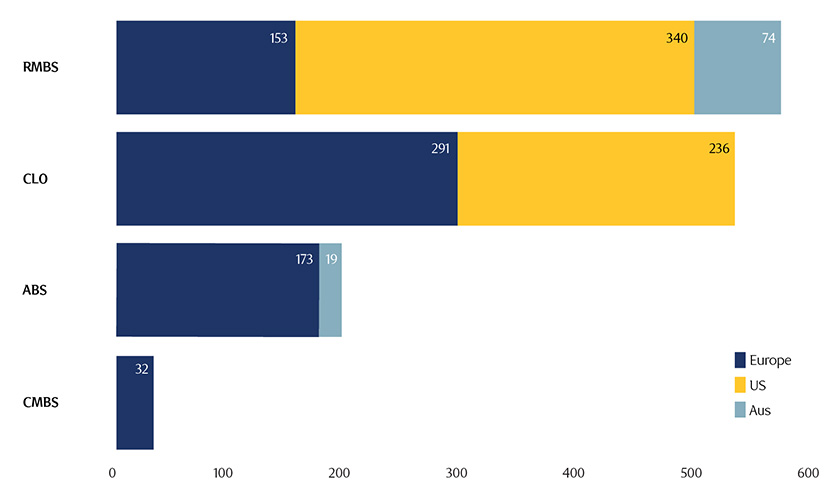
The chart below breaks this down by securitized credit sub-asset class and region.
Figure 4: European regulated investable universe by sector and region
RBC Global Asset Management, MSCI, as at 30 June 2026
1 Euro interbank offered rate
2 Sterling Overnight Index Average
3 Secured overnight financing rate